

Has music ever helped you during a rough time in your life? Has it ever altered your mood, toyed with your emotions and influenced your thought? According to research, music has far more benefits than just creating a platform for partying and popping bottles with your mates. Upon listening to music that you enjoy, your brain releases dopamine which plays a large role in positive emotional responses. Different genres of music have different impacts on your mental state and ability, and playing a musical instrument yourself can actually increase your academic performance and IQ. Simply put, music is a miracle worker of note.
Believe it or not, music travels much further than just to your eardrums. It can decrease stress, reduce anxiety and elevate your overall mood. Studies have shown that listening to music with a low tempo helps to ease stress in surgery patients. Furthermore, cancer patients who reported having listened to music regularly felt far less anxiety about their health than those that reported listening to little or no music. Finally, the repetitive rhythm and melody of music has shown to enhance our memory by teaching our brains to create patterns. This also applies to individuals with Alzheimer’s, as music can help them recall distant memories. So next time you’ve got that big test coming up, turn on your radio and listen to some tunes! Who knew studying would allow for such leisure?
Music has also been known to ease both mental and physical pain. I have experienced this first-hand, actually. In 2014 I sliced my wrist open accidentally (allow me to spare you the gory details), and the radio soothed me. While on my way to the hospital I was singing along to the music and this distracted me from my pain. I could have sworn I didn’t feel anything anymore. Emotionally, on the other hand, music can comfort people suffering from depression. Individuals I spoke to told me that music was an escape from reality for them, and a way for them to express their deepest emotions and fears. According to Anonymous, “drumming got me through some very difficult times…when my ex and I broke up, I immediately immersed myself into music in a bigger way than ever before. It made me feel as though I had a purpose and like I was worth something.” Music can also help individuals suffering from insomnia to catch some z’s. When speaking to my band-mate, Morgan, he told me that listening to music calms him and aids him in clearing his head, which in turn allows him to fall asleep.

Image: Natasha Gartner
Not every genre will have the same effects. Studies have shown that each genre of music carries its own trail of benefits. Jazz music, for example, is downtempo and great for relaxation. The smooth beats of jazz music can cause the brain to create alpha waves, which are the brain waves present when in a relaxed state. This means that jazz music is especially good for stressed individuals who want to be soothed. Daniel, a great musician and friend, told me: “it’s the highest and most expressive form. It inspires me, and that relaxes me.”
Classical music is your go-to genre if you’re looking to crack a first for your test. Classical music is known to enhance focus as well as aid the intake of information. This is primarily due to the lack of lyrics, as these can often distract individuals and cause them to perform for their mirror rather than study diagrams of the digestive system. Furthermore, this genre has shown to decrease crime. A study was conducted in London in 2003 during which classical music was played in certain train stations around the city. Within eighteen months, vandalism had decreased by 37% and robberies were down by 33%. Were the criminals too soothed by the music to perform their acts, or did the music make the station seem too prestigious to vandalise? The answer is unclear. Nevertheless, classical music is known to have a positive impact on behaviour, attitude and mood as a whole.
Pop music has a large impact on endurance and physical performance. A 2009 study concluded that listening to pop music distracts an individual, allowing them to push themselves further without even realising it. If you’re looking to get fit but are anything like me and struggle to run for more than a few seconds, whip out that NOW52 and try your luck. Pop music is also incredibly helpful for individuals suffering from depression or anxiety as the lyrics are often relatable. Morgan put it quite beautifully by saying: “relatable song lyrics are a window into the emotions of others – and in turn they can be interpreted into your own.” Individuals who feel that someone understands them are able to cope far better with their hardships, even if that someone is a celebrity on the other side of the globe. Luke, member of the indie band Red Handed, told me that he writes lyrics when he wants to express his emotions. He added, “it plays a huge part in lifting my spirits”. Many rap lyrics also discuss difficult experiences that individuals have faced, and this too can help individuals suffering from mental illnesses to feel understood. Not all lyrics are productive, however. Morgan compared music to a double-edged sword for this reason. He said, “the messages carried in songs aren’t always wise, and they aren’t always happy”. Rap songs with negative messages and overuse of explicit language can cause anger and actually have a negative impact on mental wellbeing.
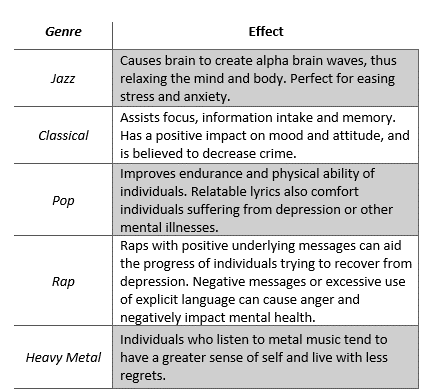
Researched and created by: Natasha Gartner
With music having so many incredible effects on our minds and bodies, why wouldn’t we take advantage of it? When next you’re studying for a test, crank up that Mozart. When you’re burning the extra calories, treat yourself to some Rihanna. Let’s spread the magic that music has to offer. From now on I’m going to live by Daniel’s wise words: “if everyone listened to good music, the world would be the most beautiful place”.
Recorded and edited by: Natasha Gartner
Available on YouTube.

